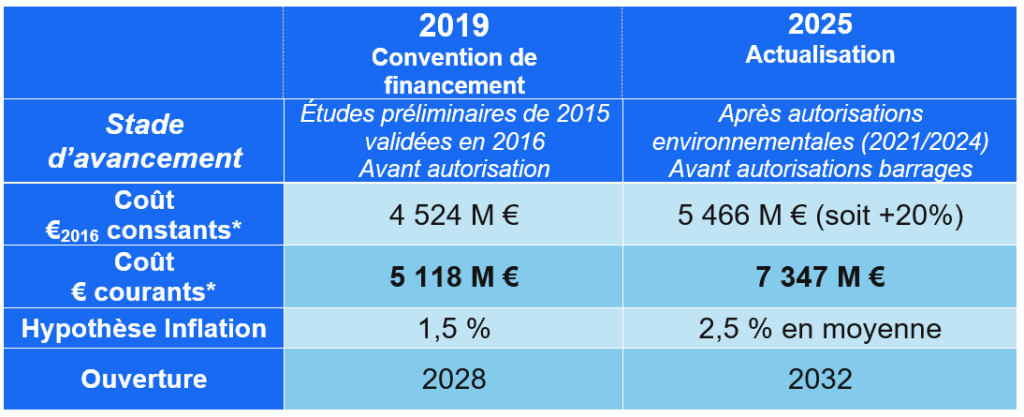
The cost of the Seine-Nord Europe Canal (€5,1 billion current) in the 2019 financing agreement is based on the technical estimates of the preliminary studies validated by the Minister of Transport in 2016. Since then, 10 years have passed, and detailed design studies have made it possible to refine the project, taking into account standards that have changed considerably.
The cost of any project can change depending on factors such as inflation, the schedule, and the context. This is why it is reassessed at key stages to provide a comprehensive overview . Obtaining the final environmental permit in August 2024 allowed for this overview, in terms of both technical aspects and permits, for the first time since 2019. Following this approval, the Canal's schedule was revised in 2025, subsequently enabling a reassessment of the project's cost. As of early 2026, the target cost at the end of the project is now estimated at €7,3 billion*.
Why does the cost change?
Several factors explain this reassessment:
Planning and inflation This represents an increase of €1,1 billion: in 2025, the completion date was pushed back to 2032 (from 2028) primarily due to the health crisis and processing delays. Regarding inflation, the consequences of the health crisis and then the war in Ukraine led to a sharp increase in material prices (between 2021 and 2022, prices skyrocketed, rising by 30% to 50% for some products). Taking into account the inflation observed in recent years and future prospects, the average inflation rate used to update the project cost has been revised to 2,5% on average, compared to 1,5% in 2019.
The evolution of standards over 10 years This represents an increase of €700 million: for example, tax reforms such as the end of the tax break on non-road diesel fuel, which public works projects benefited from before 2024, lead to an increase in the price of earthworks. Another example: laws introducing new environmental requirements result in an increase in the surface area of environmental improvements, and therefore the overall cost of the project.
Like any project, the project budget includes provisions in case of unforeseen risks. These provisions for risks were also reassessed for an amount of €300 million.
Thus the target cost has been reassessed at €7,3 billion* for a higher quality project, in line with current requirements which are more ambitious than 10 years ago in terms of safety and environment.
Comparative table between 2019 and 2025
SCSNE will continue to communicate transparently on this cost at key milestones, for example after the commitment of all major works contracts.
Constant euros, current euros, what are they?
The cost of a project can be expressed in two ways: either in constant euros , meaning without taking into account the schedule or inflation over the entire project lifecycle, or in current euros, which takes into account both observed and projected inflation until the completion of the work. The amount in current euros represents the actual cost of the project.
For the sake of transparency, SCSNE displays the target cost upon delivery of the Canal in current euros, incorporating an inflation assumption. When calculated in constant euros (2016 reference value, the year the preliminary studies were validated), the change in the CSNE amount is limited to approximately 20%.
How is the Canal financed?
The financing agreement of November 22, 2019 includes 3 components:
1. A balanced distribution (~€1,1 billion each) i.e. €2,2 billion from the State and Local Authorities (Hauts-de-France Region, Ile-de-France, Departments of Nord, Oise, Pas-de-Calais, Somme).
2. European funding (Connecting Europe Facility - CEF) :
Europe did not finance initially only 40% work; since 2024, this rate has been increased to 50% leading to a grant already secured of €868 million until the end of 2027
For 2028-2034, Europe, in its proposals for its future transport budget formulated on July 16, 2025, recalled that the Seine-Scheldt project, whose central link is the Canal, is a a priority strategic project that she hopes to see implemented. She explicitly mentions the Seine-Escaut river basin, thus signaling her support. The European coordinator of the North Sea-Rhine-Mediterranean corridor reaffirmed this during his visit to the Supervisory Board meeting on December 2, 2025.
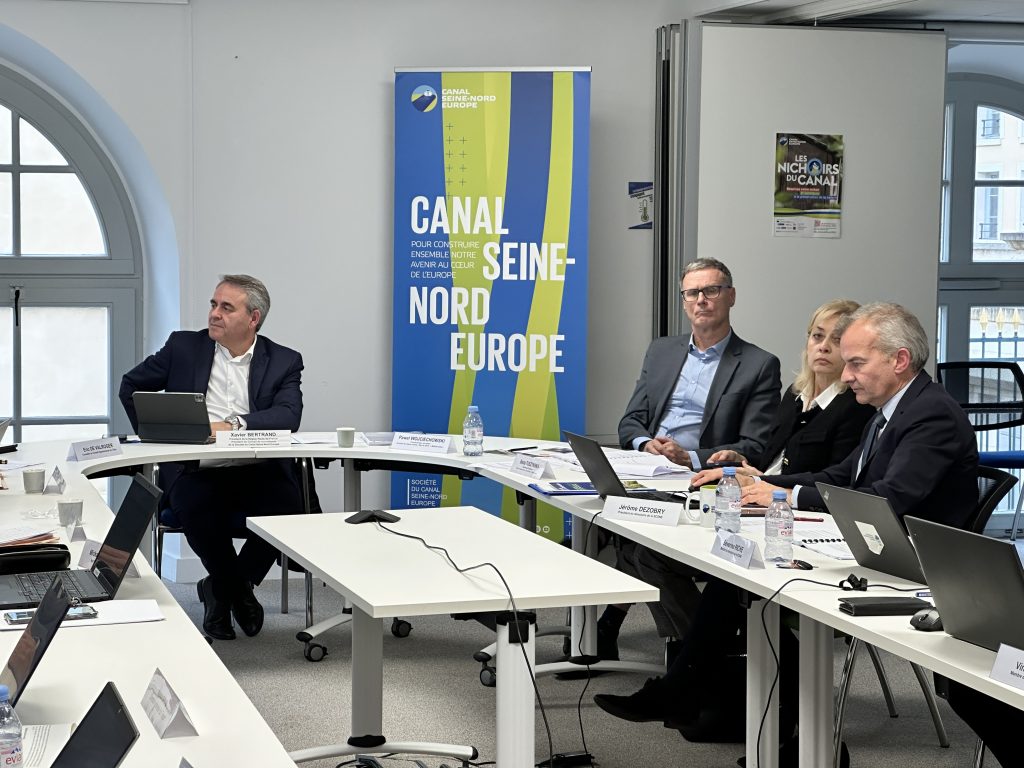
Reaffirmation of Europe's support during the visit of the European Coordinator to the SCSNE Supervisory Board meeting on December 2, 2025
3. The agreement includes mechanisms for financing project developments and inflation. Regarding the latter, the agreement provides for a cap-and-cover loan once the already approved subsidies are exhausted, financed by a revenue incentive to encourage modal shift to inland waterway transport. The Ambition France Transports initiative should contribute to the implementation of this cap-and-cover loan.
While inflation impacts the investment amount, it will also affect revenues once the Canal is operational: these will be higher, and the progress of the construction is generating interest among economic stakeholders, the future users. The challenge, therefore, is to continue maximizing the project's benefits and to prepare now, with all stakeholders, for the success of the Canal, a central link in the Seine-Scheldt network.