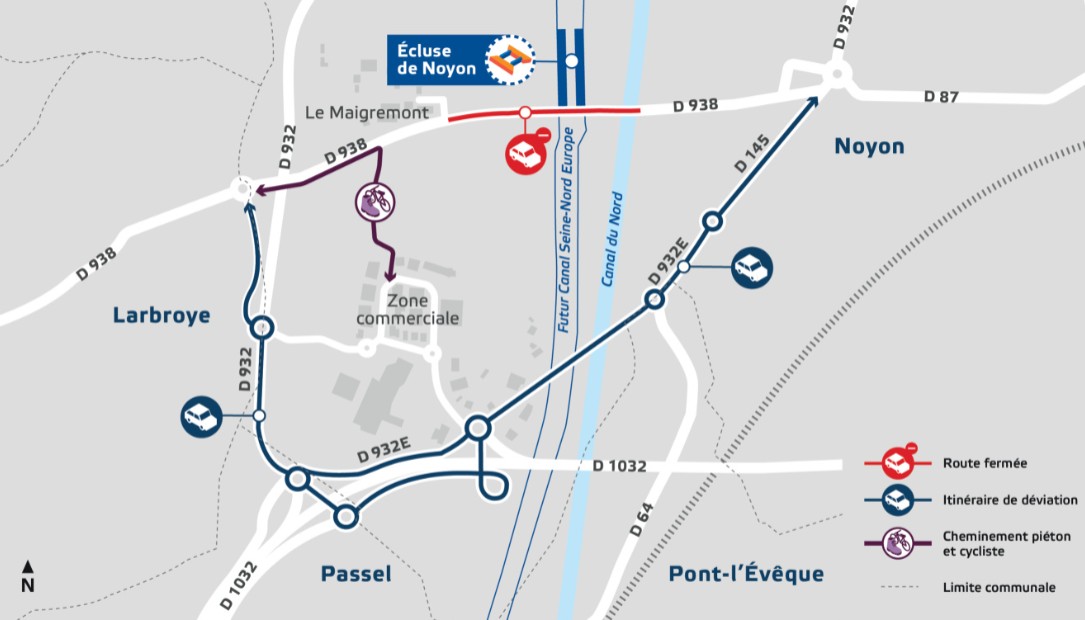
Following the contract award notification at the end of May 2026, the consortium of companies, led by Roger Martin, is carrying out preparatory work this summer, before the start of the earthworks for the Noyon lock. From the very first stages, this work will require the closure of the Rue de Montdidier (RD938) in August 2026*. What are the preparatory steps? We'll explain.
Before a construction project begins, a preparation period is necessary, both for regulatory aspects and to organize the arrival of the construction team on site. This period will notably allow the company to set up its site facilities, carry out a geotechnical survey of the site (i.e., analyze the soil), and create the construction access roads necessary for the movement of machinery within the work area.
Why close the RD938?
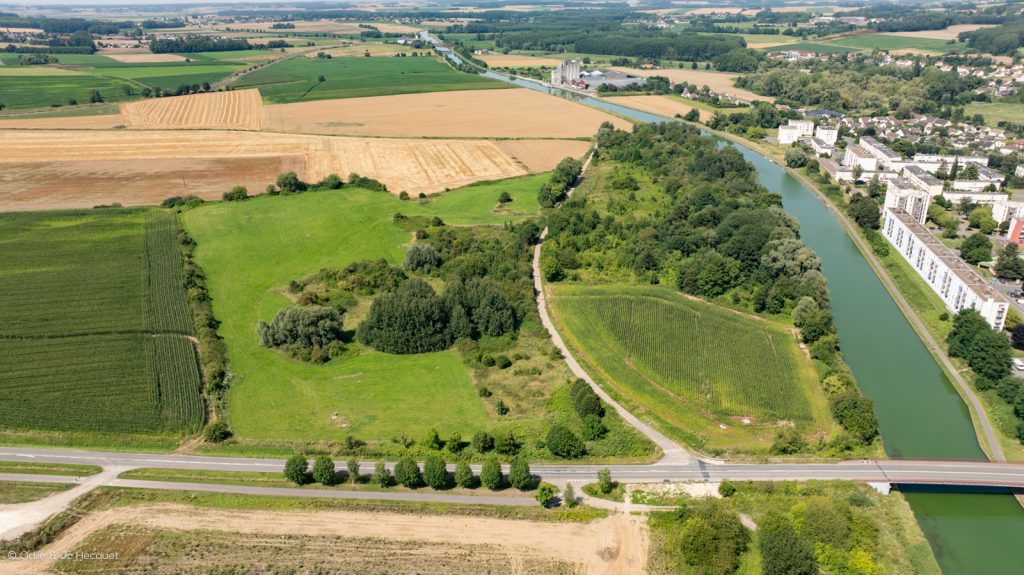
The Montdidier road (RD938) crosses the area to be excavated, a portion must be dismantled, prior to the start of the earthworks operations, before being rebuilt at the level of the downstream head of the lock when it is completed.
The road closure will therefore take place from the preparatory phase and will be maintained throughout the duration of the lock construction work, i.e. approximately five years.
The initial work
Installation of the site facilities
A site office, consisting of around twenty bungalows including a canteen, toilets and changing rooms, made available to site personnel, will be set up on the side of the RD938. Before the closure of the rue de Montdidier (RD938), we thank you for your vigilance when vehicles enter and exit the site.
Construction site access roads
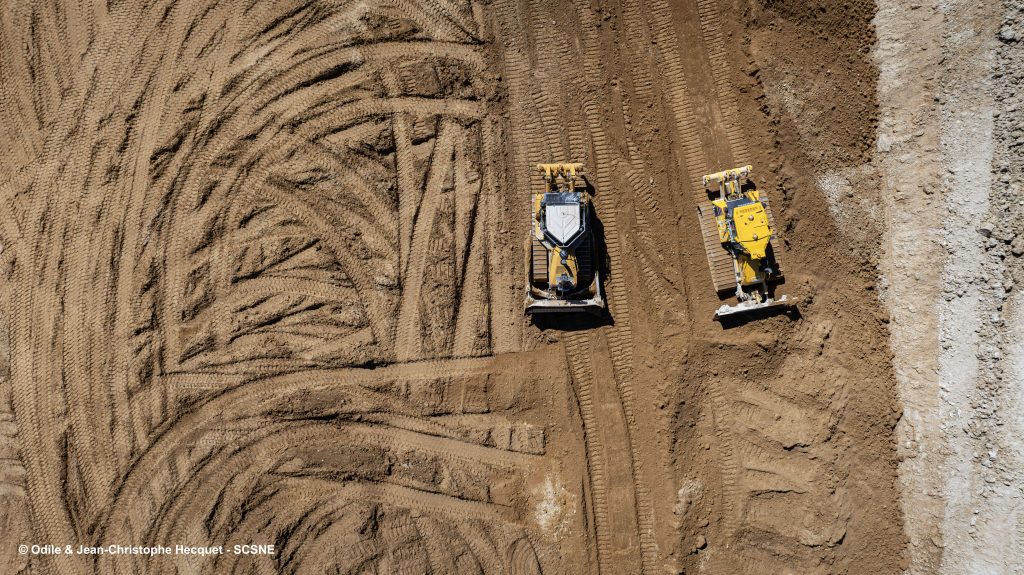
The construction access roads created this summer will provide access to the various storage areas set up next to the excavation site. These roads will be maintained throughout the duration of the project to minimize dust pollution.
Geotechnical investigation
A geotechnical investigation campaign will be conducted to characterize the soil composition. Drilling and sampling will be carried out using various techniques such as:
Core sampling, which involves taking soil samples using a tool called a core drill,
Auger drilling involves using an auger as a tool to collect materials from a relatively shallow depth, then extract and analyze them.
Mechanical excavation allows for the digging of soil to a shallow depth (up to 6 m) using a mechanical shovel. This method allows for direct observation of the different soil layers and their sequence.
Following the geotechnical investigation, the company will be able to accurately identify the different materials in place and finalize the organization of the construction site.
The extracted materials will then be sorted according to their nature (topsoil, silt, sand or clay) and stored separately in suitable areas for the duration of the work.
Did you know?
A construction site access road is generally a minimum of 5 meters wide if it is one-way and 10 to 12 meters wide if it is two-way . It is designed to support the traffic of vehicles weighing several tens of tons and is usually drained by drainage ditches at the base of the embankments.
* Depending on weather conditions and unforeseen circumstances on the construction site.