In the Compiègne area, several bridges must be demolished to make way for new structures adapted to the dimensions of the future Seine-Nord Europe Canal. These operations, planned between 2026 and 2028, are being carried out progressively, depending on the condition of the existing structures and the commissioning of the new bridges, in order to minimize the impact on traffic.
A contract has been awarded to the company Renard SAS based in the North for the deconstruction of eight structures, four of which are concerned from the 2nd quarter of 2026: the bridge of the Thourotte –Montmacq local road (VCTM) over the Oise, that of the RD 40 in Ribécourt-Dreslincourt, as well as the bridges of the RD 608 and of the Ruelle Mélique (local road) in Pimprez.
What are the impacts on traffic?
These operations will result in temporary or permanent closures of the affected roads. Depending on the condition of the structures, some lanes were closed prior to the demolitions. Since April 2025, the VCTM (Chemin de Fer du Territoire de la Montagne) has been closed to traffic, although its flow may be temporarily diverted, particularly onto the new RD66.
In Ribécourt-Dreslincourt, the RD40 was closed to road traffic in October 2025 and will also be closed to pedestrians and cyclists from April 7, 2026. In Pimprez, the RD608 will be closed from April 20, 2026 and will not be reopened, with traffic also diverting onto the RD40bis.
The VC bridge in Pimprez, closed to road traffic, will be dismantled without being rebuilt on the same site, after the completion of the new routes related to the agricultural uses of the area.
These works require careful and rigorous planning. Consultations are underway with the municipalities, the Oise Departmental Council, and all stakeholders to anticipate the consequences of the closures, whether related to waste collection, school transport, or detours. Every effort is being made to minimize the impact of the works, and information will be disseminated at each stage of the project.
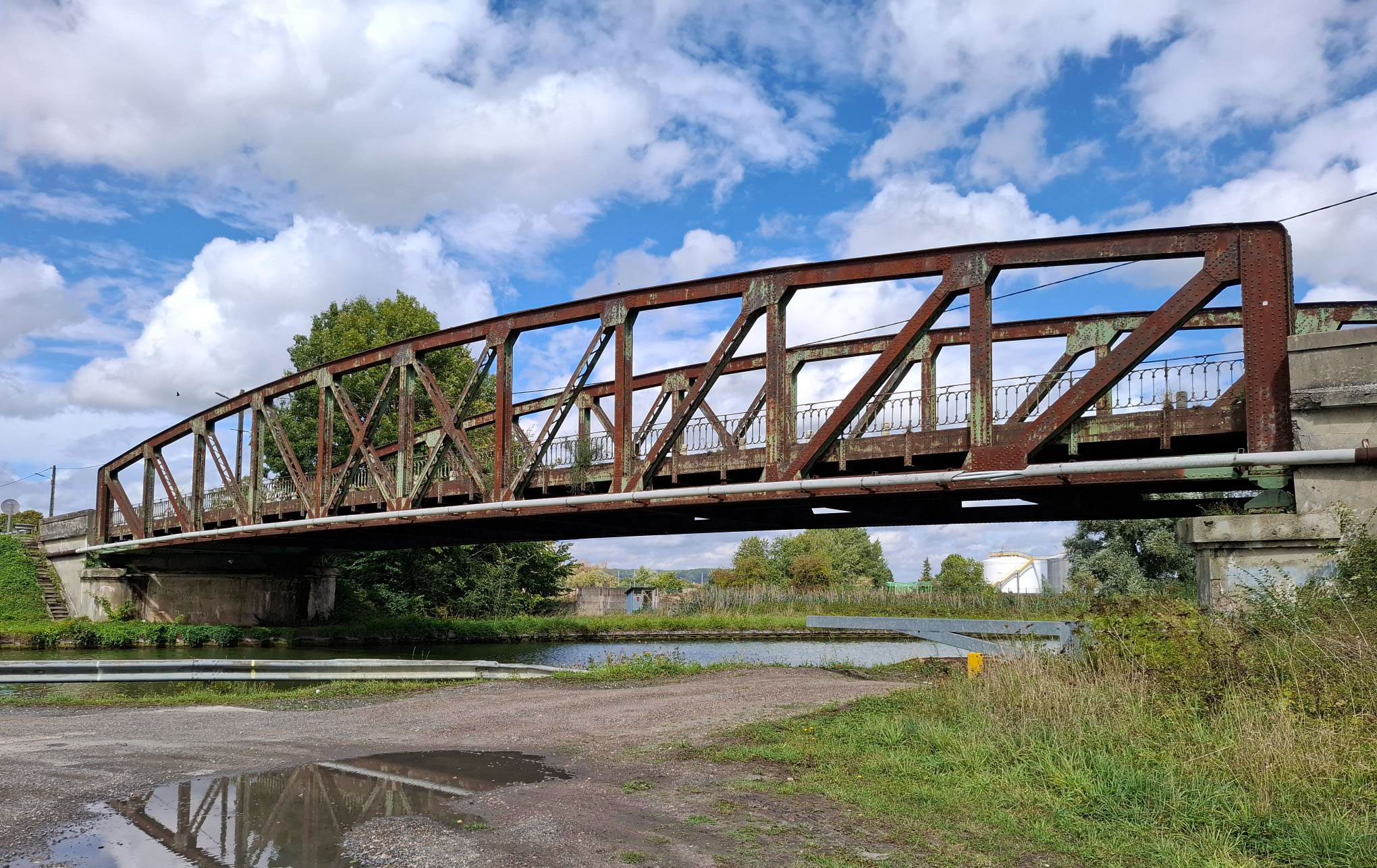
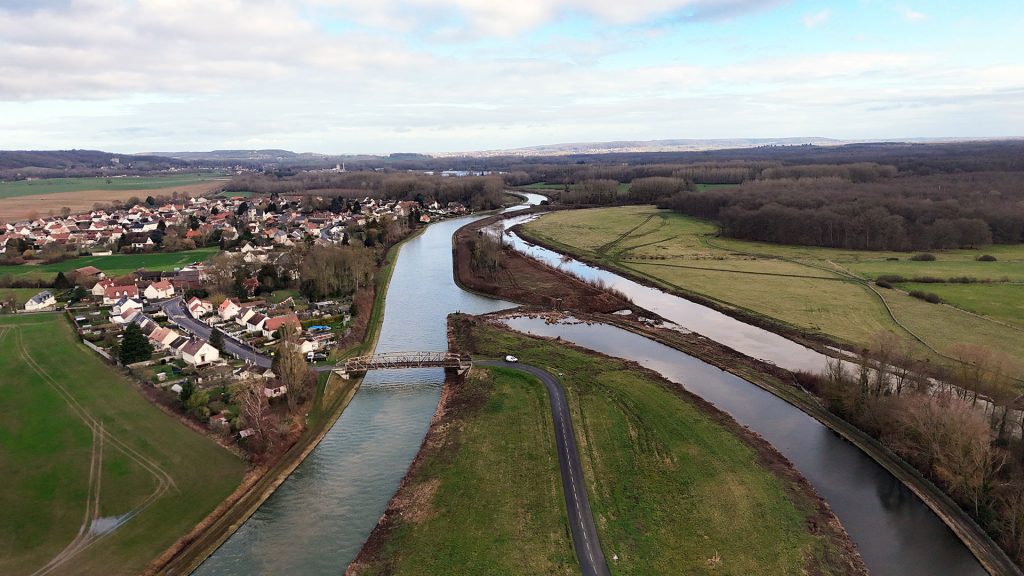
View of the RD40 bridge in Ribécourt-Dreslincourt
View of the RD608 bridge in Pimprez
How are the bridges dismantled?
The VCTM bridge will be removed by crane from the banks of the Oise River in April 2026. To lighten the bridge deck before lifting it with a crane, the concrete deck, road surface, guardrails, and signage will be removed. To prevent any parts from falling into the water, a geotextile, a special high-strength fabric, is installed under the bridge, supplemented by a safety net. The deck is then placed on a platform built specifically for its demolition downstream. Before the abutments are dismantled, geotextile-covered fences are also installed on the riverbank to protect the Oise.
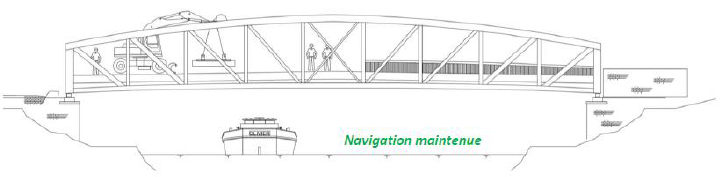
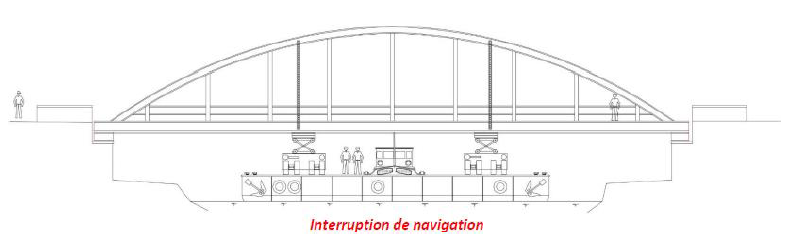
The methods used for the demolition of the three other bridges are identical. However, as the structures are larger and heavier, they will not be dismantled on site but transported by barge to the docks at Pimprez or Ribécourt-Dreslincourt. Here are the details of the operations:
1. Site preparation
A geotextile is installed along the bridge before the removal of the road surface and sidewalks in order to collect debris and protect the environment.
Once the roadway and sidewalks have been removed, the concrete slab of the bridge is cut into large blocks which are then loaded into trucks for removal.
2. Dismantling the deck
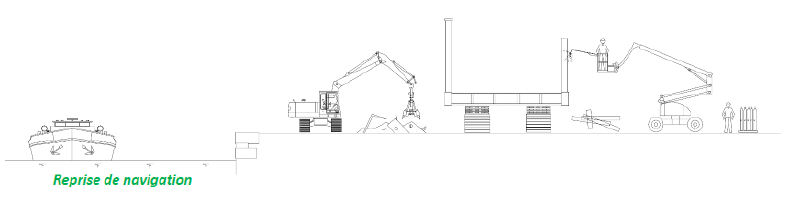
The bridge deck is then placed on a barge measuring 17 meters wide and nearly 25 meters long and taken either to the Pimprez quay or the Ribécourt-Dreslincourt quay. For this operation, navigation on the Oise Lateral Canal will be interrupted for 24 hours. The dates of the closure have been agreed upon with VNF (Voies Navigables de France) and are communicated to the barge operators in advance.
Once placed on temporary supports, the deck is cut by excavators equipped with shears. A geotextile is laid on the ground under the work area to easily collect the pieces and residue produced during the operation.
The largest sections of the deck are then cut with a blowtorch to reduce their size so they can be transported in skips and taken by truck to an authorized recycling center. Because the blowtorch melts the metal, it produces no dust. The fabric laid on the ground collects the solid residue from the melting process, keeping the area clean and controlled.
3. Demolition of the abutments
Before the abutments are demolished, protective barriers are installed on the service road of the Oise Lateral Canal to contain the demolition debris and prevent concrete from being thrown into the water. This is carried out using a mechanical excavator equipped with a special tool for breaking up concrete, as well as buckets for handling and loading the debris.
What happens to the materials used in bridge construction?
All materials from the demolition will be sent to specialized centers; the concrete will be recycled, coatings containing certain specific substances will be treated in suitable centers and the metal elements will be sent to a scrap dealer to be recycled.
*What are the different parts that make up a bridge?