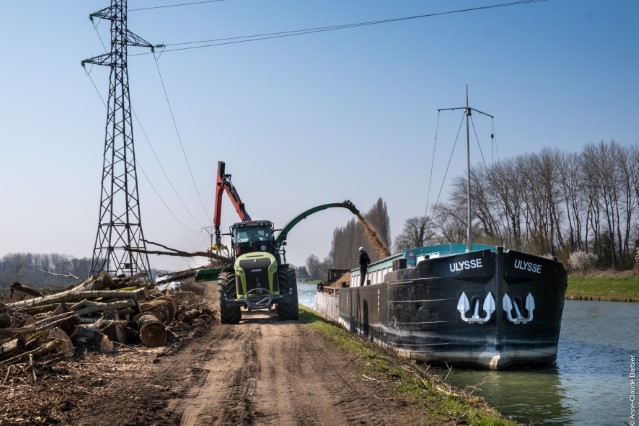
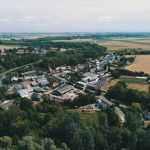
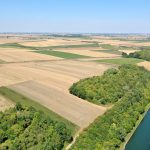
To allow the progress of the Seine-Nord Europe Canal (CSNE) work and the construction of the various structures in the sector, the land on which the structure is located must be released. Rerouting of networks, demolition of buildings or clearing of bushes and deforestation therefore continue to be carried out in sector 1, between Compiègne and Passel. In order to intervene outside the nesting period, the deforestation campaigns take place mainly from September 15 to March 15, and are carried out in strict compliance with environmental requirements.
Deforestation and clearing carried out as part of the “ERC” sequence
Deforestation operations are accompanied by environmental measures to avoid impacts on fauna and flora and, if they cannot be avoided, to reduce or compensate for them, this is the "Avoid, Reduce, Compensate" sequence known as "ERC".
Preliminary work to fell bat trees: inspection / dismantling
For example, before the work, reduction measures are taken: amphibians, possibly present in the rights-of-way, are captured and reintroduced into preserved environments, trees with cavities, likely to accommodate bats, are inspected before any intervention and cut in a specific way.
Spreading out deforestation over several seasons also allows wildlife to find carryover habitat. For example, when a bank is deforested, the fauna invades the opposite bank, then, the following year when the second edge is cut, it can again occupy the previously deforested bank whose edge has had time to reinforce.
Marking of sensitive areas (wetlands, amphibians, etc.)
What happens to the cut wood?
Although it sometimes remains on site for some time after logging, the wood is then removed and recycled into energy wood by the companies in charge of deforestation markets.
Which areas are affected for the 2023 – 2024 season?
If the bulk of the operations remaining to be carried out will take place during the 2024-2025 campaign, just before the start of the digging work on the Canal, localized deforestation operations will take place throughout the future route of the Canal between the months of September 2023 and March 2024. They will mainly consist of the manual felling of roost trees after their control, the installation of nets and amphibian fences upstream of future interventions. The main operations will be located, from South to North, in the Communes of Longueil-Annel, Le Plessis-Brion, Chiry-Ourscamp and Passel on the left bank of the current Canal.
The companies in charge of this work work, except in duly authorized exceptions, from Monday to Friday from 8 a.m. to 18 p.m.
Map of the main areas concerned
Did you know?
Compensatory measures are being implemented to preserve local biodiversity and, in the long term, to optimize it. 391 ha of compensatory developments are planned in the Compiègne area , of which more than 150 ha have already been completed since 2017 (wetlands, woodlands, ponds, hedges, etc.).
Restoration of a wetland in Chiry-Ourscamp.
Environmental developments on 6 hectares to create new alluvial afforestation in Bienville.