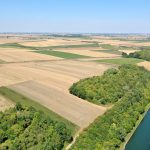
The launch of the tender process for the main works and associated services required for the construction of the Marquion lock on July 25, 2025, marks another important milestone for the Seine-Nord Europe Canal project. This step allows companies to submit bids by September 8, 2025. The contract award is expected in the second half of 2026. All tenders for the main works on the seven locks are now open (including the Montmacq lock, which has already been awarded).
A negotiated market for the Marquion lock
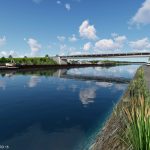
The Marquion lock, located in the Pas-de-Calais region, is distinguished by its greatest water drop on the entire route: 25,71 meters . As with the six other large-capacity locks to be built, the lock chamber's internal dimensions are 12,5 meters wide and 197 meters long. Due to the specific characteristics of the soil at this site, it also features an innovative design with thin lock walls combined with technical blocks that reuse existing materials by treating the silt. This reduces the volume of concrete used and greenhouse gas emissions compared to a traditional design with thick lock walls.
Marquion Lock (c) SCSNE - ONE5
Marquion Lock model (c) SCSNE PIXXIM
Marquion - Exterior views of the control station (c) ONE5-SCSNE
Marquion - View from the control station (c) ONE5-SCSNE
An ambition to decarbonize construction sites
As part of the selection of offers, candidates will have to meet criteria linked to the energy transition in connection with the construction sites, thus enabling the decarbonization of the site.
Each candidate must commit to ensuring the project benefits from modal shift : they are therefore asked to limit road transport for supplying the site with materials, favoring the use of rail or waterways. To encourage modal shift for this project, bids from candidates who commit to this approach will be given preferential treatment in the evaluation process.
Each candidate will also have to commit to reducing their CO2 emissions : candidates will have to explain their strategy in order to limit greenhouse gas (GHG) emissions related to the execution of the project and in particular to respect the target of maximum CO2 emission quantities set for the "material" carbon balance (concrete and steel).
A technical challenge for the 7 locks
The design of these locks represents a true technical challenge . Each of these structures was designed by the teams of the Seine-Nord Europe Canal Company and its project managers in accordance with ambitious environmental criteria. Thus, to conserve water resources, basins adjacent to the lock chamber will save a significant portion of the water during the lock emptying process, allowing it to be reused during the subsequent refilling. Any water that cannot be saved is immediately pumped from the downstream reach to the upstream reach.
Furthermore, a very high level of transport performance was required for these locks, implying that the passage time of ships must be limited as much as possible. To achieve this, the lockage times (filling or emptying the lock) were optimized to not exceed 10 to 13 minutes.
To limit the use of concrete , the walls of some locks, called lock walls, will be thin. They will rest on large masses of silt (fine soil) extracted on site and mixed with a specific proportion of lime and binders. This innovative solution was the subject of a full-scale test program near Marquion.
Particular attention has been paid to the integration of the Seine-Nord Europe Canal locks, which will create new landscapes. The Oisy-le-Verger lock, as well as those at Noyon and Allaines, are designed to welcome the public and become essential stops on tourist routes in the Hauts-de-France region.