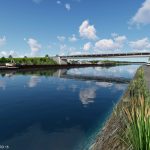
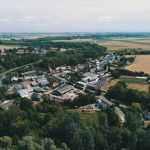
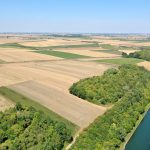
Four inland ports will be located along the Seine-Nord Europe Canal. Situated in the Noyon, Nesle, Péronne, and Marquion-Cambrai areas, they will serve as the gateway for the local economy to the Seine-Scheldt network. They will be at the heart of a true European multimodal hub, connected to both maritime ports and river terminals on the Seine, including those already present in the Hauts-de-France region, as well as those in Northern Europe.
These ports will thus become an essential tool for the ecological transition by enabling a significant shift of freight transport from road to waterway. Each site will be at least bimodal, and even trimodal for the ports of Nesle and Marquion-Cambrai, which will benefit from a rail connection. The port terminals will be multi-purpose, handling container traffic, solid and liquid bulk cargo, and heavy packages; the areas allocated within the terminals to these different traffic types will be adaptable and scalable.
The activity zones will be diversified, welcoming logistics, industries practicing modal shift and business services.
These new logistics infrastructures will integrate the principles of REV3 in the areas of digital technology, resource savings, energy and mobility. Their design was guided by ambitions of landscape, architectural and environmental quality (HQE sustainable development certification) and land sobriety.
A vast study program has been conducted since 2020 by the Hauts-de-France Region in partnership with the relevant local authorities and the Société du Canal Seine-Nord Europe (in charge of the construction of the quays), aimed at designing the port facilities and specifying the necessary interfaces with the Canal.
Very broad ongoing consultation with the project stakeholders enabled the development of development plans and then the further development of site plans. Overall, the inland ports of the Canal represent 2 linear meters of quays et more than 330 hectares of port terminals and spaces for setting up activities.
They are designed on the same principle, according to 3 parts with distinct vocations (quay, port terminal, activity zone).
Diagram of an interior port
The choice of a single governance for the 4 ports of the Canal, through the creation of the Joint Syndicate of Inland Ports in August 2023, allows for coordinated management of the sites across the port axis.
The four inland ports of the Seine-Nord Europe Canal are certified HQE Sustainable Development, in order to guarantee a high level of environmental, economic and social requirements.
The schedule for the construction of the inland ports is aligned with that of the Seine-Nord Europe Canal, with work starting in 2029 for commissioning around 2032.
In addition to the four inland ports, six local industrial or grain quays for loading and unloading ships will also be developed in Thourotte, Ribécourt-Dreslincourt and Pimprez (Oise), Languevoisin-Quiquery, Moislains (Somme) and Graincourt-lès-Havrincourt (Pas-de-Calais). Like the Canal, they will be managed by Voies navigables de France (Waterways of France).
The Seine-Nord Europe Canal and inland ports are financed by the European Union under the Connecting Europe Facility (CEF) . Design studies for the inland ports were thus supported by the DOCKSIDE PROJECT between 2020 and 2024.
4 interior ports
located in Noyon (60), Nesle (80), Péronne (80) and Marquion-Cambrai (62-59).