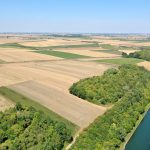
Between Compiègne and Passel, the main works of the first sector are beginning. They concern both the construction of the future Canal and associated structures, but also the accompanying environmental improvements. The Seine-Nord Europe Canal does not cross the municipality of Pontpoint, but the latter hosts one of its environmental developments: the restoration of pond no. 5, a site chosen for its strong potential for the development of biodiversity.
How is the environment taken into account?
Environmental preservation is integrated into all stages of the Seine-Nord Europe Canal project. As with any major infrastructure project, its design is based on the ERC approach: Avoid, Reduce, CompensateThe studies carried out have made it possible to avoid or reduce many effects on natural environments and compensation measures are being implemented for residual impacts. In the Oise Valley, these measures represent 424 hectares of environmental developmentmostly near the route, in order to restore or recreate habitats favorable to biodiversity. In Pontpoint, the Société du Canal Seine-Nord Europe will thus carry out an environmental development of 55 hectares on the site of pond n°5.
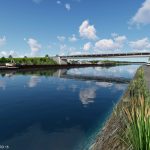
Projected view of pond no. 5 at Pontpoint, to the east
What improvements are planned for pond no. 5?
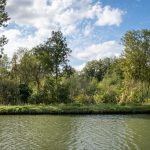
Formerly an alluvial quarry, pond no. 5 is now a large body of water. While it already supports certain species, its significant depth and steep banks limit habitat diversity. The ecological richness of a site depends not only on the presence of water, but also on the variety of environments it offers.
The ecological restoration project aims to recreate a vast network of environmental zones. It plans to preserve 15 hectares of water surface, while developing shallow water areas, reedbeds, wet meadows, and gently sloping banks.
These complementary environments will offer more favorable conditions to many species of birds, amphibians, insects and plants, while sustainably strengthening the ecological functions of the site.
Projected view of the main planned developments for pond no. 5 in Pontpoint
Why are wetlands essential?
Wetlands fulfill numerous ecological functions. They support a particularly rich biodiversity, provide breeding grounds, food, and refuge for many species, contribute to improving water quality, and participate in the natural regulation of water flow. In Pontpoint, their restoration will help strengthen the ecological connectivity of the Oise Valley.
How will the renovations be carried out?
Restoring the site requires additional materials. Some of these materials will come directly from the excavation of the pond's banks. As this volume will be insufficient, the remaining materials will be transported by river from the Canal construction sites.
This choice is part of the Seine-Nord Europe Canal Company's policy of reusing materials. Materials excavated during the canal's construction are sorted according to their characteristics in order to be reused on the various construction sites where possible, recycled, or sent to appropriate recycling channels.
The materials used at Pontpoint are exclusively alluvial materials, comparable to those already present on the site . They are sound, inert , subject to systematic controls and benefit from total traceability , from their extraction site to their implementation.
What will become of the site after the works?
Following the completion of the works, the site will be subject to ecological management for 30 years, entrusted to specialized organizations, and financed by the Société du Canal Seine-Nord Europe, in order to guarantee the proper development of the restored natural environments.
To preserve the tranquility of the wildlife and the proper functioning of the site, it cannot be accessed by the public. However, the municipality and the Seine-Nord Europe Canal Company are working together to study the possibilities, in the future, of peripheral observation trails, compatible with the objectives of biodiversity conservation and educational purposes.
Projected view of pond no. 5 at Pontpoint, to the south
How is the construction site organized?
The materials will be transported exclusively by river to a work dock on the Oise, built in advance on the future site of the MAGEO* project. They will then reach pond no. 5 via a track built on the same site (see plan).
This organization is the result of coordinated work between the Canal Seine-Nord Europe and MAGEO projects, carried out in consultation with the municipality. It allows for the pooling of resources, limiting land use and impacts on natural environments.
The location of the construction site facilities was also adapted to preserve the existing hiking trail, and particular attention was paid to the uses of the Trans'Oise and the preservation of neighboring sites.
Preliminary plan subject to change based on detailed design studies and site constraints
What are the next steps ?
The works contract was notified on April 15, 2026. After a preparation phase, the deforestation and brush clearing will be carried out at the end of 2026 / beginning of 2027**, outside the nesting period and in accordance with the requirements of the environmental authorization.
Work will continue with the construction of the work platform and site facilities. During the partial filling of the pond, rescue fishing will be carried out to protect aquatic life. The transport of materials by river, earthmoving operations, and planting will take place progressively during the following phases of the project.