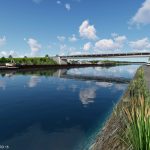
Construction of the first lock on the Canal route will begin this summer in Montmacq and Cambronne-lès-Ribécourt. A significant step planned over nearly 4 years, which will mobilize an average of 150 to 200 people per month.
Located on the 2 municipalities, the Montmacq – Cambronne-lès-Ribécourt lock ensures the junction of the upstream and downstream reaches of sector 1 and will allow the crossing of a difference in elevation of 6,41 meters.
Replacing the 2 current locks at Bellerive and Longueil-Annel, this unique crossing combined with the widening of the waterway, allowing for a higher speed, will save approximately one hour of navigation time between Compiègne and Pont-L'Évêque.
Construction of the project will begin by the end of 2024 , following the establishment of the site facilities and the creation of access roads and platforms , including the construction of the diaphragm walls. The objective is to build a watertight enclosure made of concrete walls before excavating the lock chamber , which will have a volume of approximately 200,000 m³ . The significant material deliveries and spoil management required for this project have been anticipated; while truck traffic on the surrounding roads will be unavoidable, the use of waterways – via the Oise Lateral Canal – or rail transport will be prioritized.
Did you know?
The pumping system of the Montmacq – Cambronne-lès-Ribécourt lock was designed to perform several functions.
Beyond the lock's own operation, it ensures the water supply for the entire Canal . And during peak flooding of the Oise, the pumps have the capacity to evacuate some of the water to the different reaches of the Canal , thus helping to reduce the effects of these events.
Building the lock in 4 steps
Step 1: the molded walls
The walls of the lock are excavated by trenches , into which cages of metal reinforcements are inserted.
The concrete is then poured into the metal cages to form the diaphragm walls and thus create a watertight enclosure.
Step 2: earthworks
Between the concrete walls, initial excavation is carried out over a few meters, allowing for the installation of temporary horizontal supports (large metal tubes called struts) to stabilize the ground. Then, underwater excavation is performed using a long-reach excavator, revealing the depth of the lock.
Step 3: civil engineering
The lock's foundation slab (floor) is then constructed in concrete , as are the final walls of the structure. The temporary supports are removed.
Step 4: equipment
Once the volume of the lock is achieved, the surrounding land is filled in , the operating and pumping buildings are constructed and the structure is equipped (gates, pumps, aqueducts, valves, ladders, planting of an orchard, etc.).